

I’ve been trying to figure out what Guerilladelphia actually is.
For a long time, I thought it was a festival. Then a podcast. Then a zine. Then a YouTube channel. Now it’s becoming a place for my own artwork.
But looking back over nearly 25 years, I realize Guerilladelphia has always been the same thing.
I want to help people who deserve an audience find one.
That’s the thread I somehow kept following, even when I didn’t realize I was following it.
It started with a film festival
In 2003, I created the Philadelphia Video Festival.
At the time, film festivals were packed with movies made by people who could afford to shoot on film. There were also plenty of so-called “independent” films that were actually produced by major studios through their independent labels.
That pissed me off.
I wanted to see what actually independent filmmakers were making.
So I created a festival with one stupidly simple rule:
If you didn’t shoot it on video, you couldn’t enter.
I held the festival at the Bristol Riverside Theatre in Bucks County, Pennsylvania. It was a huge success.
And then I gave the theater the profits.
Not because I had some brilliant nonprofit business model. I just wanted independent filmmakers to have a place to show their work.
That has pretty much been my problem for the next 25 years.
I care more about the thing than I care about making money from the thing.
I am not naturally good at business. I’m not particularly good with money. I have spent a ridiculous amount of my life trying to figure out how to make creative projects sustainable without turning them into something I don’t recognize.
That is still the problem I’m trying to solve.
I haven’t figured that out yet.
Then Guerilladelphia was born
Around the same time, I was going through a divorce and my life was generally falling apart.
The guy who had helped me with the Philadelphia Video Festival wanted to keep the name and continue the festival.
I wasn’t thrilled.
I had created the festival. I had come up with the idea. I didn’t really want to hand over the name.
But I was going through enough shit that eventually I said, essentially, whatever.
So I decided I’d start another festival.
I called it Guerilladelphia.
The name was a stupid little mashup of guerrilla filmmakers and Philadelphia.
The festival never happened.
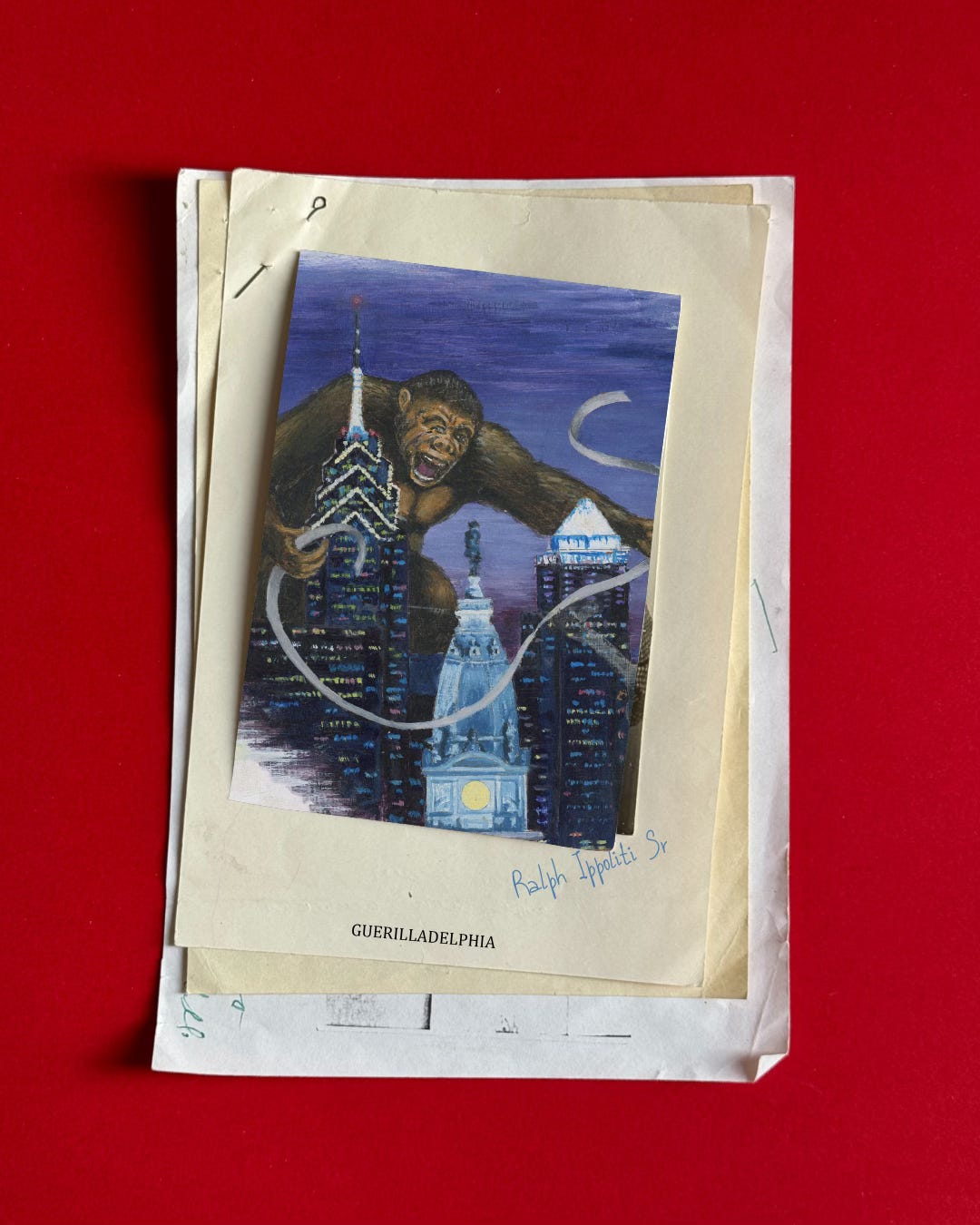
But the name stuck.
And eventually I realized that maybe the festival wasn’t really the point anyway.
Guerilladelphia became the name I put on projects that tried to do the same thing:
Give independent creators a place to be seen.
Then came podcasts
Podcasting was still this weird new technology.
I started a show called This Is Some Scene, where I interviewed independent filmmakers and, whenever I could, people whose names were considerably bigger than mine.
I had a theory.
If I could get someone interesting or famous onto the podcast, maybe people would show up for them.
And while they were there, maybe they’d discover somebody they had never heard of.
I don’t know if it ever worked.
But I still love the idea.
People are usually more impressed when I tell them I interviewed Crispin Glover, Joe Dante, Zoe Bell, Nick Hornby, or that I interviewed Tommy Wiseau from The Room ridiculously early in the podcasting era.
And, sure, those things are cool.
But honestly?
The interviews I remember most are the ones where I found somebody before anybody knew who they were.
That’s the part that still gets me.
I met R. Saint Claire through that world.
More on her in a minute.
I eventually quit This Is Some Scene, and that’s one of my creative regrets.
It was taking a toll on me, though, and I needed to stop.
Sometimes I wonder where it would be today if I hadn’t.
That’s the problem with being alive. You don’t get to see the alternate versions.
I went on to do other podcasts, trying to recreate the same basic idea: independent artists, interesting people, different kinds of creators.
None of them lasted very long.
But I kept trying to find the thing.
Then came Book Worms
Eventually, R. Saint Claire came to me with an idea.
An old-school horror zine.
Analog only.
Paper. Ink. Short stories. Comics. Games. Weird stuff.
No digital edition.
No pretending we’re a giant publishing company.
Just a physical object that somebody could actually hold.
And suddenly I recognized the idea immediately.
Book Worms Horror Zine became another version of the same thing I’ve been trying to do since 2003.
Give people a platform.
We publish established writers when we can.
But we’re especially interested in the person who might be sitting beside them.
That’s the dream.
Someone picks up Book Worms because there’s a story by Grady Hendrix.
And while they’re reading it, they discover Cat Delani.
Or somebody picks up an issue because of a writer they’ve heard of and walks away remembering somebody whose name they had never seen before.
We’re still trying to make that happen.
Getting the bigger names isn’t easy.
But we don’t stop asking.
My current ridiculous goal is to get Joe Hill into Book Worms.
I’d love to create a limited-edition Book Worms Horror Zine issue with one Joe Hill story buried inside it, alongside writers who haven’t yet reached that level of recognition.
Imagine being a horror fan and finding out there’s one Joe Hill story hidden inside a tiny, analog-only zine that only 100 or 150 people own.
That’s the kind of thing I think is cool.
Not because Joe Hill needs Book Worms.
He doesn’t.
The unknown writer sitting beside him does.
Then I started The Scroll Stopper Club
Now I’ve got The Scroll Stopper Club.
The idea is pretty simple:
Every day, thousands of songs get thrown into the algorithm.
Most of them disappear.
Occasionally, something makes me stop scrolling.
That’s a Scroll Stopper.
And most of the time, the songs stopping my scroll aren’t from enormous artists.
They’re from people I’ve never heard of.
That still gives me a little thrill.
I love discovering somebody before everybody else does.
The Scroll Stopper Club is my attempt to push those artists back into the world instead of letting them disappear underneath another thousand posts.
And now I’ve started drawing them.
Which brings me to where Guerilladelphia is today.
Maybe this is what Guerilladelphia was always supposed to become
I’ve spent most of my career working with creative technology.
Pixels. Computers. Video. Social media. Digital design. Teaching people how to make things with machines.
And now, weirdly, I’m going back to paper.
I’m drawing musicians.
I’m making gig posters.
I’m experimenting with illustrations and strange promotional ideas.
I’m trying to figure out how to make something that can compete for someone’s attention without looking like everything else in their feed.
And I keep coming back to the same question:
Can a drawing stop the scroll?
I don’t think my artwork is there yet.
I’m getting better.
But that’s the goal.
I want to make a hand-drawn image that makes somebody stop and think:
Who the hell is this band?
And if that question leads them to a song they love, then the drawing has done its job.
That’s Guerilladelphia.
It was never really about the festival.
Or the podcast.
Or the zine.
Or the YouTube channel.
Or even my drawings.
Those are just different tools I’ve picked up along the way.
The mission has stayed remarkably consistent:
Find people making something interesting. Give them a little more attention than the algorithm gave them. Put them in front of somebody who might love what they’re doing.
That’s it.
And maybe that’s why AI has made me think so much about what I’m doing now.
I’m not anti-AI.
I’m interested in technology. I’ve spent decades working with it.
But I also think we’re going to reach a point where the fact that something was actually made by somebody becomes meaningful.
A crooked line.
Ink on paper.
A strange little zine that only exists in physical form.
A drawing that isn’t perfectly rendered.
A story from a writer you’ve never heard of.
Something rare.
Something you can’t generate a thousand versions of with a button.
Something that leaves evidence behind.
Proof that somebody was here.
Maybe that’s what Guerilladelphia has been chasing for 25 years.
Not fame.
Not even necessarily success.
Discovery.
The feeling of finding somebody before everyone else does and saying:
Hey. Look at this.
So here’s to another 25 years of Guerilladelphia.
Maybe this time I’ll finally figure out how to turn it into an actual business.
I’m still working on that part.
But I’m not willing to lose the reason for doing it.
Peace.